When I was little, about 7 or 8, my dad gave me a book. It was a tan, moleskin book of poems published around the 1900s. It was a rather dog-eared copy with dark marbled pages inside the cover. Much of its delicately printed content was blotted with stains, or pages were altogether missing. The gold-rimmed cover and beautifully embossed title revealed it to be a book of "101 Best Poems". Charming speckles of mould framed the writing of poets from across the world and across time.
Being 7 or 8, I had no idea what any of the poems meant, really. But all I knew is that it was a very exciting book. It was like a treasure book! Like how you see in the movies. The texture of the cover was pleasing to touch and felt expensive. It had a reassuringly musty smell and dark stains, like it had been through life a few times already and didn't care for a wash. The poems used words like "thou" and "bequeathed", "ye" and "thine". Yes. This was definitely a book from like in the films.
Over time, thumbing through it mainly via torch light under the covers in bed (and appreciating the book's musk - grubby child that I was!), I memorised the very first poem in that book. A short poem about love by an unknown author.
It went like this:
Love not me for comely grace,
For my pleasing eye or face,
Nor for any outward part,
No, nor for my constant heart,
For these may fail, or turn to ill.
So thou and I must sever.
Keep therefore a true woman’s eye,
And love me still, but know not why,
So hast thou the same reason still
To doat upon me ever.
Granted, I had to Google the full poem now to make sure I remembered it correctly (which for the most part I did! Hooray, memory!), but in doing so I found out the author of the poem! This was quite a revelation since the book I so loved said the author was Anon. In between moving from Hong Kong where I grew up to the UK, I have since lost this book (although I sincerely hope it's hiding cosily in an attic box somewhere gathering some more mouldy freckles). But I remember it dearly, so I was excited to finally find out the author. I can put you out of your misery and tell you it was written sometime in the 16th or 17th century by one John Wilbye, an apparently well-known English madrigal composer.
So where do ill severed eyes come in, you ask? Well, being little when I read the poem, I was fixated by the line "keep therefore a true woman's eye" and I took it rather literally. So my reasoning followed something like this:
Someone keeping a woman's eye. Perhaps in their pocket. And then I thought about getting ill...and maybe gooey.
And then what about the "sever" bit?? Sever. Like SEVERED.
A severed ill, gooey eye! In the pocket of your loved one! YUK!
This all greatly appealed to my grubby little imagination, of course. How wickedly gruesome!
And how, do you ask, does Valentine's really feature in all of this? Well, in thinking about this poem today I realised I've never told anyone about this book I loved. Nor had I told anyone about this poem I had such loony imaginings of. Particularly the bit about dismembered eyes floating about in a beloved's pocket somewhere.
And I wanted to tell someone - I felt the urge to tell a specific someone. Because when you're in love, you want to tell them about these random memories. The life changing moments, the times of hardship, the raucous and embarrassing stories, your favourite foods, your feel-good films, what your job actually means (forget the silly job title), your favourite tea mug - these are the things those close to us know about us! But for me, it's those random, seemingly far aware and probably unimportant memories from either your childhood or a decade long ago that you want to share with those that you love.
It is convenient that the poem I remembered from a book I treasured so long ago is about love (although I had to read it again a few times to get the full gist! I still think of severed eyes even now) and so I wanted to share it with you too, this Valentine's Day.
Thursday, 14 February 2013


Tuesday, 3 July 2012
The Geek Manifesto Pledge
Below is an open letter I've written to Ms Kate Green, Labour MP for Stretford and Urmston. I signed a pledge, backed by the likes of author and occasional Uncaged Monkey Simon Singh, to send a copy of Mark Henderson's The Geek Manifesto to each and every MP.
There are far more eloquent letters that have accompanied copies of The Geek Manifesto to various MPs, such as this one from psychologist and
neuroscientist Chris Chambers, but I'm excited to be a small part of this movement! I will admit, this is the first time I've ever written to an MP (I know, I know!) and a cynical part of me wonders if Kate Green will even read my letter let alone the book! But I suppose its a great cause to cut your teeth on. And I'm intrigued as to what the reception and outcome will be... So, here we go:
OPEN LETTER TO MP KATE GREEN:
Dear
Ms Kate Green,
Re: Mark Henderson’s ‘Geek Manifesto’ and why science matters in politics
Firstly,
thank you for your time. I do hope you have received a copy I sent you of Mark
Henderson’s The Geek
Manifesto in the post by the end of Wednesday 4th July 2012.
Hundreds
of voters really want you to read this book! So I pledged to purchase and
send a copy of this book to a Member of Parliament as part of a movement to try
and encourage MPs to take into account scientific reasoning and results when
considering relevant legislation e.g. dealing with issues such as
healthcare, climate change, nuclear power, GM crops etc.
The
Geek Manifesto’s author, Mark Henderson, is Head of Communications at the Wellcome Trust, a global charitable organisation
that focuses on many aspects around biomedical sciences and humanities. As
stated in the book, it is often journos, accountants, lawyers etc. who are
making decisions on very important issues, and yet with NO scientific knowledge
at all. I read Physics at the University of Manchester and went on to study a
History of Science Masters’ Degree, which involved heavily the work and support
of the Wellcome Trust. As such, I am passionate about educating others as to
the importance of scientific reasoning and am excited to have the opportunity
to contact you with regards to Mark Henderson’s book.
Living
in an apparently advanced society as we do, it seems short sighted, naïve and
frankly dangerous to neglect employing the scientific method when policy
making. It seems ludicrous that scientific expertise is rejected or that advice
is strategically omitted at some of the highest levels of decision making in
this country.
The
idea for sending this book, The Geek Manifesto, came from blogger Dave Watts, who wrote:
I was reading the Geek Manifesto and I thought “every one of our MPs should
be reading this” then I thought, in the spirit of the book, “OK, let’s make it
happen” so…
What I want you to do is pledge to buy one copy of the book.
Once we have 650 pledges we can buy the books, then I will find a way of
delivering them to the House of Commons.
The
publishers of The Geek Manifesto have kindly agreed to match every pledge, thus
aiding the pledge and allowing all 650 MPs to have a copy of the book once 325
pledges signed – and I am one of them. As this is a collective movement,
pledges are sending copies to MPs across the board and to ensure that each MP
receives a copy.
Although
I now live in London, I lived, studied and worked in Manchester for over 9 years.
And, I more recently worked at the new MediaCityUK development in Salford
Quays. This is why I have chosen to send a copy of The Geek Manifesto to you,
as MP for Stretford and Urmston. I’ve seen first-hand the exciting developments
and progression taking place in the UK at Salford Quays, close to your constituency – embracing new
technology and reasserting the UK as a leader in our field, with technological
and academic innovation and excellence. Let us not fail ourselves and future
generations by dangerously committing ourselves to
making hugely important decisions based on inadequate counsel – and this
argument is valid across all industries and departments, but none particularly
more pressing that in scientific technologies and affected industries.
I
will also be emailing my current MP, Mr Chuka Umunna, for Streatham, who has
received a copy from another pledger.
For
more information about The Geek Manifesto, please go to this website:
Thank
you again for your time and I very much look forward to hearing you and
your colleagues’ thoughts on The Geek Manifesto. Happy reading!
Kind
regards,
Briony Gunson
Friday, 1 June 2012
How to be a Grown Up Woman - A Ferrifrump Discourse
It's a Thursday night before the "Jub-lee" Bank Holiday
where Britain pays homage to Queenie in her 60th Reigning (Raining) Year. My
thoughts are headlong into the impending debauchery of the oncoming weekend. I
don't think I'm alone here when I say that bank holidays for me have come to
represent extended periods in the pub, where time is spent rambling
passionately (and depending on rum levels, likely incoherently) amongst good
friends (or that new weird guy who I just met at the bar).
The definition between being exquisitely hung-over and
nicely tipsy is muddled by day-on-day drinking. By weekend's finish, I’ll likely have some new
drunken, embarrassing stories to add to my repertoire and, with a heavy liver
and a significantly lighter wallet, I'll utter those famous and long betrayed
words: Never Again. I'll promise to
myself that I *will* do something more wholesome (and try not to join the 27 Club). Perhaps I’ll go
camping and hiking in the Lake District, or at least do the gardening whilst
drinking Jasmine tea and listening to Radio 4. Yes, I do the gardening whilst
wearing a floppy straw hat and a twee summer dress. Fantasies aside, I still
feel like I'm practicing "being a grown up" (whatever that means). As
such, I don't feel I'm quite old (or middle class) enough to be able to mix Radio
4 with gardening *just* yet.
However, when my impending debauchery partner, Lydia, texts to ask what I'm
doing on Thursday night, I pull back my thoughts from the inevitably decrepit
corners of the ensuing weekend and merrily declare "Nada."
Mouth open, eyes wide; I reply: "YES!"
Author and self-described “woman, yes, but still funny”
Caitlin Moran is interviewing Jennifer Saunders for Radio 4's series Chain Reaction.
Lydia, being the splendid girl that she is, a) has tickets, b) has a spare, and
c) is kind enough to ask me. Huzzah! Lydia, like any half-witted person (Lydia
has much wit I should say - I'd say she almost has 3/2 wit!) is a big French & Saunders fan.
But she was also dead excited as she's a big fan of Moran and has recently read
How To Be A Woman. As a result of
Lydia reading this, there have been many animated conversations down the pub as
to the preferred nomenclature when referring to a...well, lady garden/va-jay-jay/cunt/vagina/lady
bits/axe wound (delete and/or screw up face in disapproval, as appropriate). I
had recently bought a (male) friend a copy of How To Be A Woman as a gift but with
the strict instructions that he must report back to me with his findings. Post
haste!
As for me, I've grown up on a diet of Blackadder, Monty Python and French & Saunders with lashings of Ab Fab, so I'm
delighted at the thought of seeing, in the flesh, a hugely influential woman whom
I and my sisters idolise. And the evening ended up providing more than just
sheer entertainment in the end. Listening to Ms. Saunders (as Caitlin referred
to her, and I will do so hereon in - never call her 'Jen', though. Never 'Jen'),
I was left pondering some home truths about comedy, feminism, alcohol and
friendship.
Both women are quick witted and the exchanges are warmly received by the audience. I sympathised with Ms. Saunders as she recalls her time moving around schools as a Forces child (I myself went to five different schools growing up - my parents were just hippies and like to move around). And I bit my lip with anticipation when Caitlin asked Ms. Saunders if she was a feminist. I've been having many conversations recently (with myself and with others!) about the definition of feminism and of society's associations and incarnations of feminism. I think of myself as a feminist but have been confused and at times dismayed how the definition of feminism sometimes seems to involve a myriad of conflicting or awkward political and ideological hues. Perhaps I'm not sophisticated enough to distinguish the different shades with precision!
But surely Jen, sorry, Ms. Saunders, would be able to set me straight on the definition of feminism? She's caught off guard, and Caitlin waits anxiously to hear the answer. Ms. Saunders isn't sure of a definition. Exactly my troubles, Jen. *Exactly*. We establish that, as a general rule, it's about equality and move gracefully on.
There's talk of Bananarama and French & Saunders partying the night away and providing much inspiration for recreating scenes involving falling out of taxis when pissed (apparently some Bananas can drink more vodka than others). This pleases me greatly as Bananarama was the first cassette tape I ever bought (yes, kids - cassettes). Being as Ab Fab and Bananarama were two major protagonists in the 90s for me, my watching endless episodes of Ab Fab and listening to Bananarama now takes on a lot more depth and meaning.
Saunders recalls her worst professional experience - the hellish nightmare of working with a
heavily neuortic and pregnant Roseanne. And of her intimidation when singing in
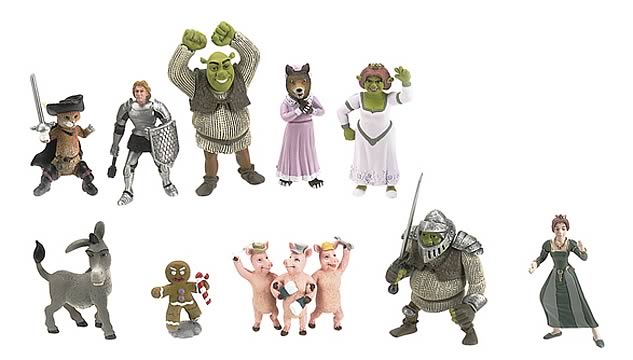
Shrek
2 (we are yet to establish the existence of small,
plastic evil Saunders). Saunders then speaks of her sadness that the London’s
BBC Television
Centre may be knocked down. As I have worked at MediaCity in Salford, I had
(perhaps naively) thought the controversy was borne from the inconvenience of
the move and scepticism of "The North". I hadn't considered the
strong element of nostalgia and the mourning she and so many others would feel
when the building ceases to be.
Nostalgia for the BBC moves to nostalgia for champagne
soaked halcyon Ab Fab heydays. Saunders smiles and declares that it's all been
a really excellent way to earn a living. She mentions being flown to New York
"just to go to a party"; to go and be Patsy and Eddie for a night with
all-you-can-drink champagne. Another seminal realisation hits me: it becomes
clear to me the probable source of the almost crass obsession behind my sister
and I's Bubbles addiction is from Ab Fab (Cava, Prosecco, Champagne, slightly
off white wine = Bubbles).
But what, Moran asks, is the motivation behind her sterling,
BAFTA, Emmy award winning comedy? Revenge? Power? Money? Saunders said French
& Saunders started because they wanted to do it for themselves. And that,
she concludes, is the best thing. To be in a room with a friend and just making
each other howl and hurt with laughing so much. But she coyly admits that the
fat cheque at the end is certainly a driving force.
Then, as with all good things, it's sadly at an end. And
Lydia and I are grinning as we walk away, chatting excitedly about all that has
been at the Radio 4 event. I'm thrilled at having seen Ms. Saunders and Ms.
Moran but am also pleasantly surprised by all the food for thought and inspiration
(hence this blog post).
Looking ahead to this bank holiday weekend and considering I'm still practicing "being a grown up", I say sod the gardening. I've done Radio 4 already. So I'll don the twee summer dress, head down to the pub, get some Bubbles and enjoy the resulting face and stomach cramps and possible cava/nose related mishaps from howling with laughter down the pub with my friends. Cheers!
If you want to listen to the JOY that is this last series episode of Chain Reaction, apparently you'll have to wait until August (boo!). But Jennifer Saunders was asked if she would take up the torch and set alight the new series of Chain Reaction by interviewing another.... Will it be Dawn French? Bananarama?! Who knows! I'll be keeping a keen ear/eye on that and let you know.
Thursday, 24 February 2011
Science and Social Media
I was kindly awarded an academic bursary during my MSc in the History of Physical Sciences at The University of Manchester's CHSTM by the British Society for the History of Science. As per the conditions of that bursary, I was employed to write about my experiences during that year. I've been wanting to share that article for some time (other than proudly displaying it on my fridge when wanting to impress visitors... the Pokemon magnets holding it aloft detract from it somewhat) and thought if you've got it, blog it (or some similar catchy, go-getting phrase). It focuses on what I had learnt over that year, coursing my intellectual tantrums and conceptual dilemmas over my understanding of the authority and standing of science in society.
It was published in the BSHS's Viewpoint publication in June 2009.

I thoroughly enjoyed writing this and I'd be interested to know of other people's opinions on science the changing perceptions of its role in society. And since starting work for a digital media company, I've been increasingly wondering what kind of role social media will have in shaping the future of science. Social media platforms like Twitter and Academia.edu are changing the way in which all people, from your average physics undergraduate to your University professor, share, critique and consume knowledge. But the classic peer to peer circle has been blown wide open by the open source sharing of information through blogging by scientific journalists, science enthusiasts and its critics. The huge growth in the use of social media has given a voice to every man and his proverbial dog. And this ability to share and access information is changing the face of just about everything in society, including ecomonics and politics (just look at wikileaks...).
Where social media once may have been seen by some as the refuge of the self-indulgent (and those who like to tell everyone what they had for breakfast), there are now highly influential people from all walks of life heavily engaging with the public via social media platforms such as Twitter. Manchester's own Prof Brian Cox and American physicist Michio Kaku both have a significant presence on Twitter with large followings. So how, and is, their presence on Twitter altering the public perception of science? How does the way in which scientific communities generally engage with social media influence the public perception of science? Does social media engagement make science more accessible to the layman? Or could it damage the autonomy of science through its dissemination via more casual and nontraditional formats? The debate around the relationship between science and the public, and the responsibility of scientists to communicate effectively was more recently taken up by eminent Sir Paul Nurse in Horizon: Science Under Attack, of which I could write a whole other blog post around (and probably will) but I'll wrap it up for now. Although... what's your view of the future of science and social media?
It was published in the BSHS's Viewpoint publication in June 2009.

I thoroughly enjoyed writing this and I'd be interested to know of other people's opinions on science the changing perceptions of its role in society. And since starting work for a digital media company, I've been increasingly wondering what kind of role social media will have in shaping the future of science. Social media platforms like Twitter and Academia.edu are changing the way in which all people, from your average physics undergraduate to your University professor, share, critique and consume knowledge. But the classic peer to peer circle has been blown wide open by the open source sharing of information through blogging by scientific journalists, science enthusiasts and its critics. The huge growth in the use of social media has given a voice to every man and his proverbial dog. And this ability to share and access information is changing the face of just about everything in society, including ecomonics and politics (just look at wikileaks...).
Where social media once may have been seen by some as the refuge of the self-indulgent (and those who like to tell everyone what they had for breakfast), there are now highly influential people from all walks of life heavily engaging with the public via social media platforms such as Twitter. Manchester's own Prof Brian Cox and American physicist Michio Kaku both have a significant presence on Twitter with large followings. So how, and is, their presence on Twitter altering the public perception of science? How does the way in which scientific communities generally engage with social media influence the public perception of science? Does social media engagement make science more accessible to the layman? Or could it damage the autonomy of science through its dissemination via more casual and nontraditional formats? The debate around the relationship between science and the public, and the responsibility of scientists to communicate effectively was more recently taken up by eminent Sir Paul Nurse in Horizon: Science Under Attack, of which I could write a whole other blog post around (and probably will) but I'll wrap it up for now. Although... what's your view of the future of science and social media?
Thursday, 6 January 2011
Every Journey Has A Beginning...
...and classically a middle, although if I am feeling impatient I will just skip to the end. So this is where we start.
What be the purpose of this blog? I have a personal diary which I scrawl illegibly and unintelligibly into. I otherwise spend most my time rambling about my thoughts aloud anyway. So why the blog? Why the blog not, I say.
So I will blog on with little initial purpose and direction and see what monsters evolve during the process. Greetings and Good day to you.
What be the purpose of this blog? I have a personal diary which I scrawl illegibly and unintelligibly into. I otherwise spend most my time rambling about my thoughts aloud anyway. So why the blog? Why the blog not, I say.
So I will blog on with little initial purpose and direction and see what monsters evolve during the process. Greetings and Good day to you.
Subscribe to:
Comments (Atom)